

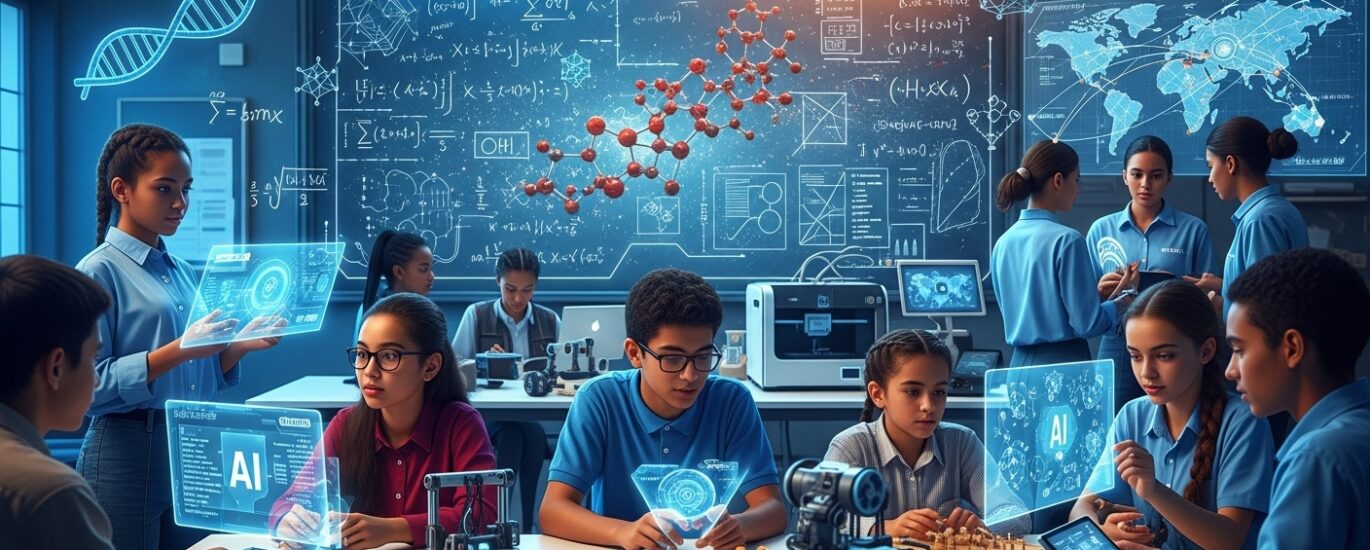
When we first established Ududorle Academy as students at Covenant University, we had a bold vision: to revolutionize how young people engage with Science, Technology, Engineering, and Mathematics. As brothers passionate about Information and Communication Engineering and Management Information Systems, we witnessed firsthand how traditional STEM education was failing to prepare students for the rapidly evolving technological landscape.
Fast forward to 2025, and that vision has become reality. Our academy has successfully guided over 1,500 students through transformative STEM journeys, and we’ve learned invaluable lessons about what the future of education truly looks like. Today, we want to share those insights with you.
The Wake-Up Call: Why Traditional STEM Education is Failing
Last month, we received a call from Mr. Adebayo, a parent whose son Kemi was struggling in his computer science program at university. “He was brilliant in high school math and science,” Mr. Adebayo explained, his voice filled with concern. “But now he’s failing programming courses and says he can’t keep up with the technology.”
Kemi’s story isn’t unique. We’ve encountered hundreds of students who excelled in traditional STEM subjects but struggled when faced with real-world applications, collaborative projects, and rapidly evolving technologies. The problem isn’t with the students – it’s with an educational system that hasn’t evolved with the times.
The Five Pillars of Future-Ready STEM Education
Through our work at Ududorle Academy and our continued studies at Covenant University, we’ve identified five critical trends that are reshaping STEM education in 2025 and beyond. More importantly, we’ve developed practical approaches to integrate these trends into effective learning experiences.
1. Artificial Intelligence as a Learning Partner, Not a Replacement
When ChatGPT first gained popularity, many educators panicked, fearing AI would make learning obsolete. At Ududorle Academy, we took a different approach. We saw AI as the ultimate personalized tutor – available 24/7, infinitely patient, and capable of adapting to each student’s learning style.
Take Folake, one of our recent success stories. She was struggling with calculus, feeling overwhelmed by complex derivative problems. Instead of traditional drill-and-practice methods, we introduced her to our AI-enhanced learning platform. The system identified that she learned best through visual representation and real-world applications.
Within two weeks, Folake was using AI to:
- Generate step-by-step visual solutions to calculus problems
- Create personalized practice problems based on her interests (she loves architecture)
- Receive instant feedback and explanations for her mistakes
- Connect calculus concepts to architectural design principles
“The AI doesn’t give me answers,” Folake explains. “It asks me questions that help me find the answers myself. It’s like having a patient teacher who never gets frustrated with me.”
Our Innovation at Ududorle: We’ve developed proprietary AI tutoring systems that complement human instruction rather than replacing it. Our students learn to use AI as a tool while developing critical thinking skills that no machine can replicate.
Real-World Application: Students learn to prompt AI effectively, evaluate AI-generated solutions critically, and understand when human expertise is irreplaceable. These skills are becoming essential for any STEM career.
2. Project-Based Learning: Solving Real Problems with Real Impact
Traditional STEM education teaches concepts in isolation. Students memorize formulas without understanding their applications, study theories without seeing their relevance. Our project-based approach turns this model upside down.
Consider our recent “Clean Water Initiative” project. Fifteen students from different age groups worked together to address water quality issues in a local community. The project required:
- Chemistry knowledge to test water samples and understand contamination
- Mathematics skills to calculate flow rates and design efficient filtration systems
- Engineering principles to build functional water purification devices
- Technology integration to monitor water quality using IoT sensors
- Communication skills to present findings to community leaders
Temi, a 16-year-old participant, discovered her passion for environmental engineering through this project. “I never understood why I needed to learn about pH levels and chemical reactions until I saw children getting sick from contaminated water,” she says. “Now I’m planning to study environmental engineering at university.”
The Impact: This project wasn’t just an academic exercise. The team’s solution was implemented in three local schools, providing clean drinking water to over 500 students. Learning becomes powerful when it creates real change.
Our Methodology:
- Every project addresses genuine community challenges
- Students work in interdisciplinary teams mixing age groups and skill levels
- Industry mentors provide guidance and feedback
- Solutions are implemented and their impact measured
- Students present their work to real stakeholders, not just teachers
3. Personalized Learning Pathways: Because Every Mind is Unique
One-size-fits-all education is not just ineffective – it’s harmful. We learned this lesson from Chinedu, a brilliant student who came to us after nearly dropping out of his engineering program.
“I thought I was stupid,” Chinedu recalls. “I could visualize complex mechanical systems in my head, but I couldn’t solve the math problems in the textbook. Every class felt like torture.”
Our comprehensive assessment revealed that Chinedu was a spatial-visual learner trapped in a verbal-analytical teaching system. We designed a personalized pathway that leveraged his strengths:
Months 1-2: Foundation building using 3D modeling software to explore mathematical concepts Months 3-4: Engineering mathematics taught through CAD design projects Months 5-6: Advanced calculus and physics applied to mechanical system design Months 7-8: Independent project designing and building a functional robot
Today, Chinedu is thriving in his mechanical engineering program and has won two robotics competitions. The difference wasn’t his intelligence – it was an approach that honored how he naturally learns.
Our Personalization Process:
- Comprehensive learning style and interest assessment
- Customized curriculum based on individual strengths and goals
- Flexible pacing that allows students to master concepts before advancing
- Multiple pathways to the same learning objectives
- Regular reassessment and pathway adjustments
4. Interdisciplinary Integration: Breaking Down Subject Silos
The greatest innovations happen at the intersection of disciplines. At Ududorle Academy, we’ve eliminated traditional subject boundaries in favor of integrated learning experiences.
Our “Smart City Design” program exemplifies this approach. Students work on designing sustainable urban environments, which requires:
- Physics and Engineering: Understanding structural forces and energy systems
- Mathematics: Calculating population density, traffic flow, and resource allocation
- Computer Science: Programming simulation models and data analysis
- Biology and Chemistry: Designing waste management and air purification systems
- Social Studies: Understanding urban planning policies and community needs
Adunni, who initially considered herself “just a math person,” discovered her love for environmental science through this program. “I realized that math isn’t separate from saving the environment – it’s essential to it,” she explains. “Now I want to use data science to fight climate change.”
The Result: Students develop systems thinking and understand how different fields of knowledge interconnect. They graduate with both deep expertise and broad perspective – exactly what employers in the modern economy seek.
5. Global Collaboration: Preparing for a Connected World
The future belongs to those who can collaborate across cultures, time zones, and disciplines. Our global partnership program connects Ududorle Academy students with peers around the world.
Currently, our students are working on collaborative projects with:
- Students in Singapore developing sustainable energy solutions
- Peers in Canada studying climate change impacts
- Young innovators in Germany exploring renewable technologies
- Researchers in Kenya investigating agricultural technology
Segun, who initially struggled with confidence, now leads video conferences with students from four continents. “Working with students from different countries taught me that good ideas can come from anywhere,” he says. “I’ve learned as much about problem-solving from a student in rural Kenya as from my textbooks.”
Global Skills Development:
- Cross-cultural communication and collaboration
- Time management across different time zones
- Digital collaboration tools and platforms
- Appreciation for diverse perspectives and approaches
- Language skills through technical communication
Technology Integration: Not Just Using Tech, But Understanding It
As Information and Communication Engineering students ourselves, Zion and I understand that true technological literacy goes beyond using apps and software. It requires understanding how technology works and how to create it.
Our technology integration approach includes:
Coding as a Language: Every student learns programming, not as a separate subject, but as a communication tool for mathematical and scientific ideas.
Hardware Understanding: Students build and program physical devices, understanding the connection between abstract code and real-world systems.
Data Science Applications: Real datasets from local organizations provide context for statistical analysis and machine learning concepts.
Digital Ethics and Safety: Understanding the social implications of technology and responsible innovation practices.
Success Story: The App That Changed a Community
Last year, our students noticed that many elderly residents in their community struggled to access healthcare information. Instead of just discussing the problem, they built a solution.
The team developed a mobile app with:
- Voice-activated health information in local languages
- Medication reminders with family notifications
- Direct connection to local healthcare providers
- Emergency contact features with GPS location
The app now serves over 2,000 users and has been adopted by the local health ministry. Students didn’t just learn programming – they learned how technology can serve humanity.
The Ududorle Difference: Where Education Meets Innovation
What makes our approach unique isn’t just what we teach, but how we learn alongside our students. As current university students ourselves, Zion and I bring fresh perspectives and cutting-edge knowledge directly from our own academic experiences.
Our Unique Advantages:
- Student-Taught Innovation: Our instructors are current students who understand modern learning challenges
- University Connections: Direct partnerships with Covenant University and other institutions provide advanced research opportunities
- Industry Integration: Internship and mentorship programs with leading technology companies
- Sibling Collaboration: Our complementary expertise in engineering and information systems provides comprehensive STEM coverage
Looking Ahead: The Skills Students Need for 2030 and Beyond
Based on our research and industry connections, here are the critical skills students will need:
Technical Skills:
- AI collaboration and prompt engineering
- Data analysis and interpretation
- Systems thinking and design
- Computational modeling
- Digital fabrication and prototyping
Human Skills:
- Creative problem-solving
- Cross-cultural collaboration
- Ethical reasoning
- Communication across technical and non-technical audiences
- Adaptive learning and resilience
Meta-Skills:
- Learning how to learn efficiently
- Identifying reliable information sources
- Managing information overload
- Balancing human judgment with AI assistance
- Maintaining curiosity and wonder
Real Results: The Numbers Don’t Lie
Our innovative approach has produced measurable results:
- 94% of our STEM students report increased confidence in mathematics and science
- 87% choose advanced STEM courses after completing our programs
- 76% of our graduates pursue STEM degrees at university
- Our students have won 23 national science and technology competitions
- 15 student-developed solutions have been implemented in local communities
The Parent Perspective
Mrs. Okonkwo, whose daughter completed our program last year, shares her observation: “My daughter came home excited about learning for the first time in years. She wasn’t just memorizing facts – she was creating solutions, asking questions, and seeing possibilities everywhere. That’s when I knew Ududorle Academy was different.”
A Personal Note from the Founders
As we write this blog post during our final semester at Covenant University, we’re more convinced than ever that the future of education lies in breaking traditional boundaries. The same innovative thinking that led us to establish Ududorle Academy continues to drive our approach to STEM education.
We’ve seen shy students become confident presenters, struggling learners become passionate researchers, and isolated individuals become collaborative team leaders. The transformation isn’t just academic – it’s personal, social, and deeply meaningful.
Your Child’s STEM Future Starts Here
The question isn’t whether STEM education will continue evolving – it’s whether your child will be prepared for that evolution. At Ududorle Academy, we don’t just teach the STEM of today; we prepare students for the STEM of tomorrow.
What You Can Do Today:
- Schedule a Campus Tour: See our innovative learning spaces and meet our student instructors
- Attend a Sample Class: Experience our project-based, AI-enhanced learning approach
- Meet Other Families: Connect with parents whose children have transformed their relationship with STEM
- Explore Partnership Opportunities: Learn about our university preparation and industry connection programs
The Future is STEM, and STEM is the Future
As Covenant University students who have experienced both traditional and innovative education, we know that the future belongs to students who can think critically, collaborate globally, and innovate constantly. These aren’t just academic skills – they’re life skills that will serve our students regardless of their ultimate career choices.
Ready to Join the STEM Revolution?
The world needs problem-solvers, innovators, and ethical leaders who understand both technology and humanity. At Ududorle Academy, we’re not just teaching STEM – we’re nurturing the next generation of change-makers.
Your child’s journey into the future of STEM education starts with a single step. Take that step today.
Contact Ududorle Academy: Where today’s students become tomorrow’s innovators.
About the Authors: Oseifemi and Zion are siblings and co-founders of Ududorle Academy. Currently studying Information and Communication Engineering and Management Information Systems at Covenant University, they combine academic excellence with practical teaching experience to create innovative educational solutions. Their vision is to make quality STEM education accessible, engaging, and transformative for every student.

